Published on 3.07.2026
Sergio Dávila is a PhD candidate in Urban Studies at the Universidad Autónoma Metropolitana in Mexico City and an exchange researcher at the Estonian Academy of Arts. His work explores how cities can become spaces of coexistence between humans and other species through biophilic design, participatory processes, and creative governance. As a researcher, teacher, and frequent conference speaker, Dávila bridges design, ecology, and politics to imagine more-than-human futures for our urban environments.
Copying in design is often framed as replication or technical translation, particularly within biomimicry, where biological mechanisms are extracted and applied to human-centred solutions.1, 2 This article proposes an alternative understanding, approaching copying through non-human mimicry and the semiotics of play.
The discussion is anchored in Boquila trifoliolata, a Chilean climbing plant capable of altering its leaf morphology to resemble neighboring species. While this phenomenon is well documented,3 its mechanisms remain unresolved and contested.4 Rather than resolving these uncertainties, the article treats Boquila as a site where copying exceeds clear causal explanation.
Drawing on Gregory Bateson’s notion of play as a metacommunicative frame5 and Erving Goffman’s theory of framing,6 mimicry is understood not as faithful reproduction but as a provisional and exploratory gesture. In this sense, copying in nature operates as a relational process in which meaning emerges through context and interaction as opposed to fixed correspondence.7, 8, 9
Extending this perspective to design, the article asks how design might invite mimicry as play instead of enforcing copying as a solution. It argues that design artefacts can function as scaffolding, serving as mediums for relationships, framing interactions through ambiguity, affordances, and open-ended cues that enable both human and non-human engagement over time.
By reframing biomimicry as a critique of instrumental copying, the article contributes to debates on authorship, learning, and coexistence, suggesting that copying, understood as play, becomes a careful practice of relating under conditions of uncertainty.
Copying Under Suspicion
Copying has long occupied an uneasy position within art, design, and architecture. It is frequently treated as derivative or secondary, an act that follows rather than invents. Modern design discourse has reinforced this distinction, privileging originality while casting reproduction as diminished or suspect.10, 11
Within biomimicry, copying often appears as technical transfer: biological mechanisms are identified, abstracted, and translated into human applications.12, 13 In this logic, copying is instrumental, serving performance, optimisation, or sustainability goals. Nature becomes a repository of solutions awaiting extraction.
Yet outside anthropocentric frames of interpretation, copying is not necessarily derivative. In biological contexts, mimicry operates as a mode of survival and adaptation, embedded within ecological relations.14 Organisms respond to patterns, shapes, and signals in ways that suggest not passive imitation but situated calibration. From a biosemiotic perspective, such responses occur within perceptual worlds structured by meaning instead of abstraction.15, 16, 17
This article proposes a shift in how copying is understood within biomimicry. Rather than treating copying as replication or translation, it approaches copying as relational intelligence, and not abstract reasoning but sensitivity and responsiveness within a shared environment. Biomimicry fails when it treats copying as instruction; it begins when copying is framed as play.
This reframing moves the discussion away from questions of whether nonhuman beings are intelligent and toward a more productive inquiry: how does copying function as a semiotic practice? And how might design learn to copy with care, without collapsing meaning into control?
Copying as Intelligence (Not Imitation)
In ethology, the concept of supernormal stimuli describes how organisms may respond more strongly to exaggerated signals than to the natural cues for which their perceptual systems evolved.18, 19 Artificial amplification of colour, proportion, or pattern can trigger intensified behavioural responses, revealing that form operates as sign within specific ecological relations.
Such phenomena expose a form of semiotic vulnerability. When signals are amplified beyond their ecological calibration, they can hijack attention and behaviour. In this sense, copying without restraint becomes manipulative: it intensifies meaning rather than negotiating it.
Contemporary human environments increasingly operate through such amplification. Hyper-stimulating media, exaggerated visual cues, and optimised sensory experiences function as supernormal signals that collapse context into immediate stimulus.20 These forms of copying are high-stakes and instrumental, prioritising capture over interpretation.
By contrast, non-human mimicry typically operates within ecological bounds. Instead of amplifying signals, it aligns with local conditions. Mimicry therefore is not the reproduction of an ideal form but a contextual adjustment within a field of relations.21 From a biosemiotic perspective, such adjustments occur within species-specific perceptual worlds, where meaning emerges through interaction and not abstraction.22, 23, 24
This distinction allows us to differentiate between two modalities of copying:
1. Literal copying operates within a single interpretive frame, where meaning is fixed and resemblance is evaluated in terms of accuracy and performance.
2. Playful mimicry, by contrast, introduces a shift in framing, suspending literal equivalence and allowing resemblance to function as an exploratory relation.
The distinction is not moral but structural: literal copying seeks control, while playful mimicry tests relations. This becomes especially visible in the case of Boquila trifoliolata.
Boquila trifoliolata: Radical Relational Copying
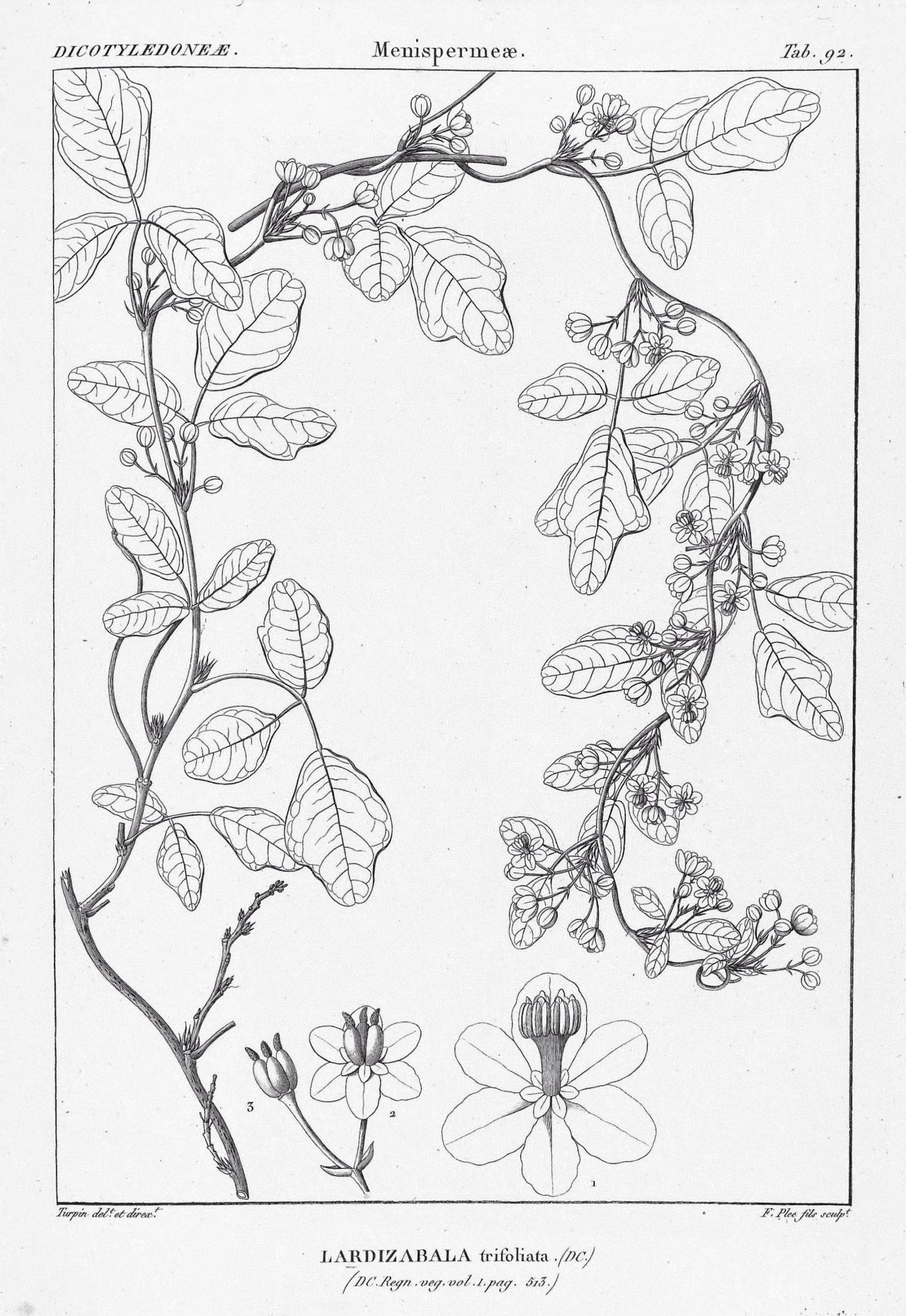
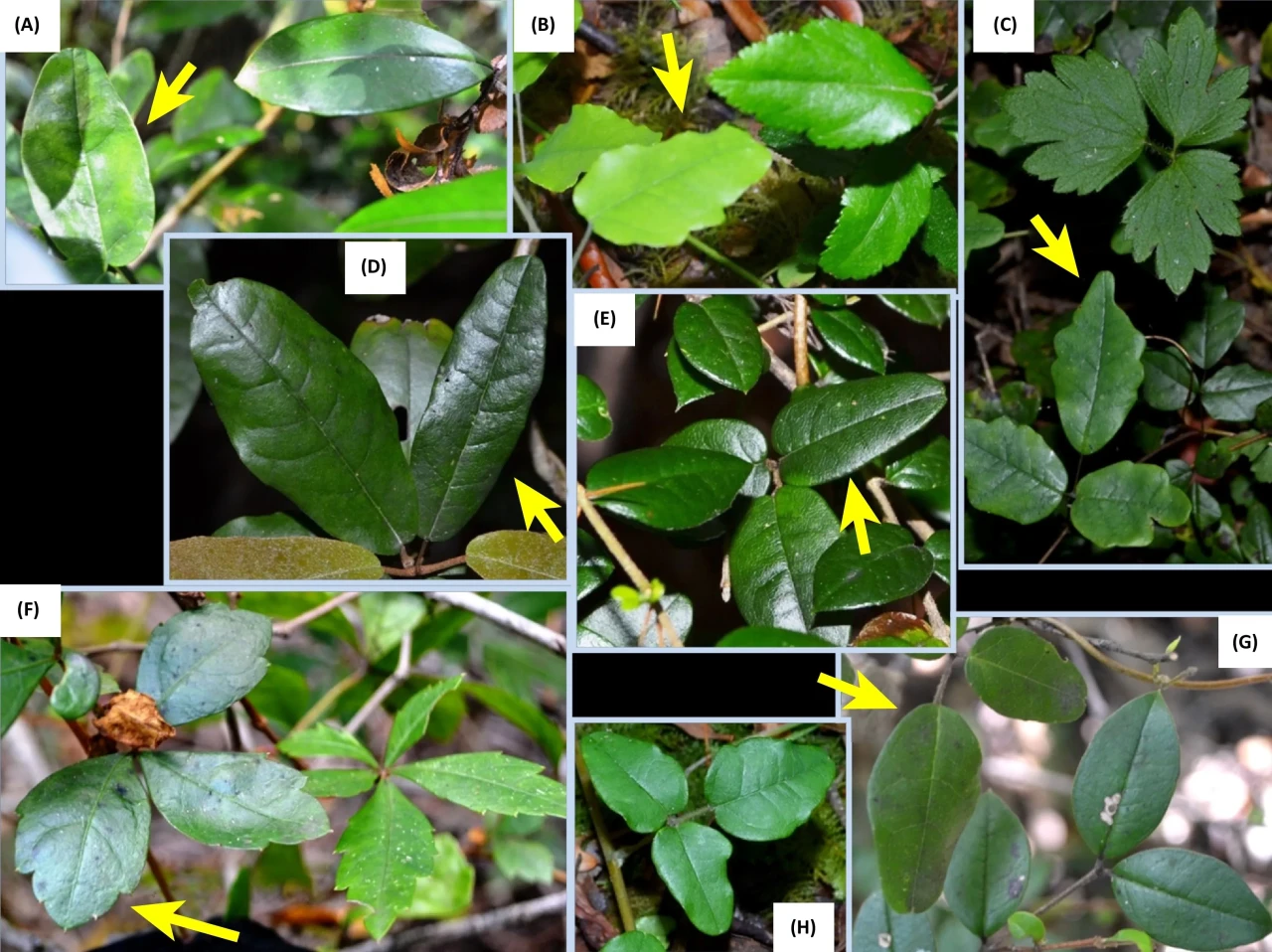
Boquila trifoliolata, a climbing plant native to South American forests, has been documented to exhibit remarkable morphological plasticity, producing leaves that resemble those of nearby host plants in shape, size and colouration.25 This resemblance has been associated with reduced herbivory, suggesting an adaptive function.
The mechanisms underlying this phenomenon remain unresolved. Hypotheses range from chemical signaling to more speculative accounts involving visual perception, though no consensus has been reached.26 This article does not attempt to resolve these debates, but treats Boquila as a site of epistemic uncertainty, where copying exceeds clear causal explanation.
Boquila does not reproduce a botanical type in abstraction. It modulates its morphology in proximity to specific neighbours. Its resemblance appears less taxonomic than contextual, a form of calibration rather than replication. In this sense, mimicry functions as relational adjustment and not faithful copying.
Importantly, this adjustment differs from the logic of supernormal stimuli. Instead of amplifying signals, Boquila remains within ecological bounds, aligning its form with its surroundings instead of exaggerating them.27 Its mimicry does not intensify attention; it redistributes it.
This allows Boquila to be understood not as an anomaly to be explained nor as evidence of plant intelligence, but as a case in which copying operates without fixed correspondence. Resemblance here is provisional, situated, and open-ended.
To articulate this more precisely, mimicry must be understood not as replication, but as a framed interaction. It is to this question that Bateson’s theory of play turns.
Mimicry as Play: Framing Resemblance Beyond Literal Copying
If mimicry in Boquila trifoliolata can be understood as contextual calibration rather than replication, the question becomes how such copying operates semiotically. Bateson’s theory of play provides a useful entry point.
Bateson argues that play is not defined by specific behaviours but by a metacommunicative signal that frames those behaviours.28 In play, actions resemble serious activity while being marked as non-literal. A bite is not an attack; a chase is not a hunt. Meaning shifts because the frame shifts. Context precedes content.
Goffman extends this insight by describing frames as schemata that organise experience and guide interpretation.29 He introduces the notion of keying, through which an activity is transformed into another mode while preserving its form. Play can thus be understood as a keying of serious action: resemblance remains, but its meaning is altered.
Read together, Bateson and Goffman allow mimicry to be understood not as literal copying but as a framed practice. Resemblance becomes not so much exact as provisional, a gesture that tests similarity without collapsing difference.
Importantly, such interactions do not require symmetry. In interspecies contexts, full mutual understanding is unlikely, yet interaction remains possible through partial alignment and temporal mediation.30 What matters is not equivalence but the possibility of uptake. In this sense, mimicry operates as a low-stakes invitation.
For design, this shift is significant. If copying depends on framing, then design participates in the construction of those frames. Rather than replicating biological forms, design can create conditions in which resemblance becomes a site of interaction.
The question is no longer how to copy nature accurately, but how to frame encounters so that mimicry can be explored without being fixed.
Design as Platform: Participatory Methodologies for More-than-Human Play
If mimicry is understood as framed and exploratory, then design’s role shifts accordingly. The question is no longer how to copy nature, but how to create conditions in which resemblance can be explored as a relation.
The concept of mirror neurons offers a useful, if limited, model. These neurons activate both in performing and observing actions, suggesting a form of learning through embodied resonance.31 While their interpretation remains debated, they point to a broader idea: learning can occur through exposure and alignment instead of instruction. Here, the notion is used heuristically, not to attribute neurological processes across species, but to suggest that copying can function as attunement.
This shift calls for a reorientation of design methodology. Conventional biomimicry often treats nature as a source of optimised solutions to be translated into design.32, 33 By contrast, participatory design emphasises co-creation, iterative engagement and shared authorship.34, 35 Rather than prescribing outcomes, it constructs platforms, kits, environments, or situations, through which interaction can unfold.
As Paul Atkinson notes, participatory methodologies position participants at the centre, with designers acting as facilitators rather than authors.36 When extended beyond human users, this orientation suggests a broader field of participation, where interaction is not based on intentional collaboration but on material engagement and response.
In this context, design artefacts can be understood as scaffolding and as mediums for relationships. Instead of delivering fixed functions, they frame interactions through ambiguity, affordances, and open-ended cues that allow different forms of engagement over time. Some interactions are taken up, others ignored; meaning emerges more through use than prescription.
From a biosemiotic perspective, such artefacts function as mediators within overlapping perceptual worlds.37, 38 They do not translate perfectly between species, but create conditions for partial alignment. Interaction does not depend on mutual understanding, but on the possibility of uptake.39
This reframes biomimicry as a participatory practice. Instead of replicating biological forms, design stages encounters in which relational processes can emerge. The emphasis shifts from solution to scaffolding, from performance to exposure, and from control to responsiveness.
In this light, design operates less as a means of replication and more as a platform for relation, where copying becomes more a mode of engagement than a technique for transfer.
Copying Lessons: Toward a Playful Symbiotic Design
If biomimicry is reframed as participatory play, then what designers copy shifts from form to relation. The question becomes not how to reproduce natural structures, but how to engage the relational logics through which living systems persist.
Consequently, copying can be understood more as the copying of lessons than appearances.
Biological systems offer multiple such lessons. Fungal networks distribute resources across boundaries between species through decentralised, adaptive connections.40 Lichens emerge through sustained symbiotic association, where form is more the result of coexistence than domination.41 These examples point not to models for replication, but to relational strategies.
The endosymbiotic theory proposed by Lynn Margulis suggests that complex life evolves through incorporation rather than competition, as distinct organisms enter into stable, interdependent associations.42 From this perspective, evolution itself can be understood as a history of relational integration.
Read alongside Bateson’s notion of play43, such integration does not occur instantaneously but through repeated interaction. Provisional associations may stabilise over time, transforming from contingent encounters into structural relations. Difference is not eliminated but maintained within new configurations.
For design, this implies a shift in method. If copying involves engaging relational processes, then biomimicry becomes less about transferring solutions and more about constructing the conditions in which such processes can unfold. Participatory approaches already move in this direction by decentering authorship and emphasising collective formation.44, 45, 46
In this light, biomimicry becomes less a technical discipline and more a practice of attentiveness. It does not seek to control or replicate nature, but to remain in relation with it.
This shift introduces important tensions. Interpreting biological processes as lessons risks metaphorical projection. Extending participation beyond human actors raises questions about agency and representation. Moreover, relational approaches may still be appropriated within extractive systems that reduce them to aesthetic or functional strategies.
These concerns are not obstacles but conditions of the work. They foreground the need for caution in how copying is framed and practiced.
If biomimicry once asked how to copy nature’s solutions, it might now ask how to participate in its negotiations. Copying therefore becomes not a claim of mastery, but a sustained practice of relation.
References
- Janine M. Benyus, Biomimicry: Innovation Inspired by Nature (New York: HarperCollins, 1997).
- Julian F. V. Vincent et al., ‘Biomimetics: Its Practice and Theory’, Journal of the Royal Society Interface, 3.9 (2006), 471–482 <https://doi.org/10.1098/rsif.2006.0127>.
- Ernesto Gianoli and Fernando Carrasco-Urra, ‘Leaf Mimicry in a Climbing Plant Protects against Herbivory’, Current Biology, 24.9 (2014), 984–987 <https://doi.org/10.1016/j.cub.2014.03.010>.
- Thomas E. White and Naoki Yamashita, ‘Boquila trifoliolata Mimics Leaves of Artificial Plants to a Remarkable Degree’, Plant Signaling & Behavior, 17.1 (2022), 2055416 <https://doi.org/10.1080/15592324.2022.2055416>.
- Gregory Bateson, ‘A Theory of Play and Fantasy’, Psychiatric Research Reports, 2 (1955), 39–51.
- Erving Goffman, Frame Analysis: An Essay on the Organization of Experience (Boston: Northeastern University Press, 1986; first published 1974).
- Timo Maran, Ecosemiotics: The Study of Signs in Changing Ecologies (Cambridge: Cambridge University Press, 2020) <https://doi.org/10.1017/9781108942850>.
- Jesper Hoffmeyer, ‘Semiotic Scaffolding of Living Systems’, in Introduction to Biosemiotics, ed. by Marcello Barbieri (Dordrecht: Springer, 2008), pp. 149–66 <https://doi.org/10.1007/1-4020-4814-9_6>.
- Jakob von Uexküll, A Foray into the Worlds of Animals and Humans: With a Theory of Meaning (Minneapolis: University of Minnesota Press, 2010; first published 1934).
- Walter Benjamin, ‘The Work of Art in the Age of Mechanical Reproduction’, in Illuminations, trans. by Harry Zohn (New York: Schocken Books, 2008; first published 1936).
- Rosalind Krauss, The Originality of the Avant-Garde and Other Modernist Myths (Cambridge, MA: MIT Press, 1986).
- Benyus, Biomimicry.
- Vincent et al., ‘Biomimetics’.
- Graeme D. Ruxton, Thomas N. Sherratt and Michael P. Speed, Avoiding Attack: The Evolutionary Ecology of Crypsis, Warning Signals and Mimicry (Oxford: Oxford University Press, 2004).
- Maran, Ecosemiotics.
- Hoffmeyer, ‘Semiotic Scaffolding’.
- von Uexküll, A Foray into the Worlds of Animals and Humans.
- Nikolaas Tinbergen, The Study of Instinct (Oxford: Oxford University Press, 1951).
- Deirdre Barrett, Supernormal Stimuli: How Primal Urges Overran Their Evolutionary Purpose (New York: W. W. Norton, 2010).
- Barrett, Supernormal Stimuli.
- Ruxton, Sherratt and Speed, Avoiding Attack.
- Maran, Ecosemiotics.
- Hoffmeyer, ‘Semiotic Scaffolding’.
- von Uexküll, A Foray into the Worlds of Animals and Humans.
- Gianoli and Carrasco-Urra, ‘Leaf Mimicry’.
- White and Yamashita, ‘Boquila trifoliolata Mimics Leaves’.
- Ruxton, Sherratt and Speed, Avoiding Attack.
- Bateson, ‘A Theory of Play and Fantasy’.
- Goffman, Frame Analysis.
- Colin Jerolmack, ‘Humans, Animals, and Play: Theorizing Interaction when Intersubjectivity is Problematic’, Sociological Theory, 27.4 (2009), 371–89 <https://doi.org/10.1111/j.1467-9558.2009.01353.x>.von Uexküll, A Foray into the Worlds of Animals and Humans.
- Giacomo Rizzolatti and Corrado Sinigaglia, ‘The Functional Role of the Parieto-Frontal Mirror Circuit’, Nature Reviews Neuroscience, 11.4 (2010), 264–74 <https://doi.org/10.1038/nrn2805>.
- Benyus, Biomimicry.
- Vincent et al., ‘Biomimetics’.
- Pelle Ehn, ‘Participation in Design Things’, in Routledge International Handbook of Participatory Design, ed. by Jesper Simonsen and Toni Robertson (London: Routledge, 2008), pp. 92–101.
- Elizabeth B.-N. Sanders and Pieter Jan Stappers, ‘Co-creation and the New Landscapes of Design’, CoDesign, 4.1 (2008), 5–18 <https://doi.org/10.1080/15710880701875068>.
- Paul Atkinson, ‘Orchestral Manoeuvres in Design’, in Open Design Now: Why Design Cannot Remain Exclusive, ed. by Bas van Abel et al. (Amsterdam: BIS Publishers; Premsela; Waag Society, 2011).
- von Uexküll, A Foray into the Worlds of Animals and Humans.
- Hoffmeyer, ‘Semiotic Scaffolding’.
- Jerolmack, ‘Humans, Animals, and Play’.
- Peter McCoy, The Mycocultural Revolution: Transforming Our World with Mushrooms, Lichens, and Other Fungi(Portland, OR: Microcosm Publishing, 2022).
- Lynn Margulis, Symbiotic Planet: A New Look at Evolution (New York: Basic Books, 1998).
- Margulis, Symbiotic Planet.
- Bateson, ‘A Theory of Play and Fantasy’.
- Ehn, ‘Participation in Design Things’.
- Sanders and Stappers, ‘Co-creation’.
- Atkinson, ‘Orchestral Manoeuvres in Design’.