Published on 3.07.2026
Mia Tamme is an artist, writer and community organiser. She researches heritage crafts, from textile arts to sailing the sea, by browsing through archives and engaging in handwork. Tamme lives and works in Tallinn.
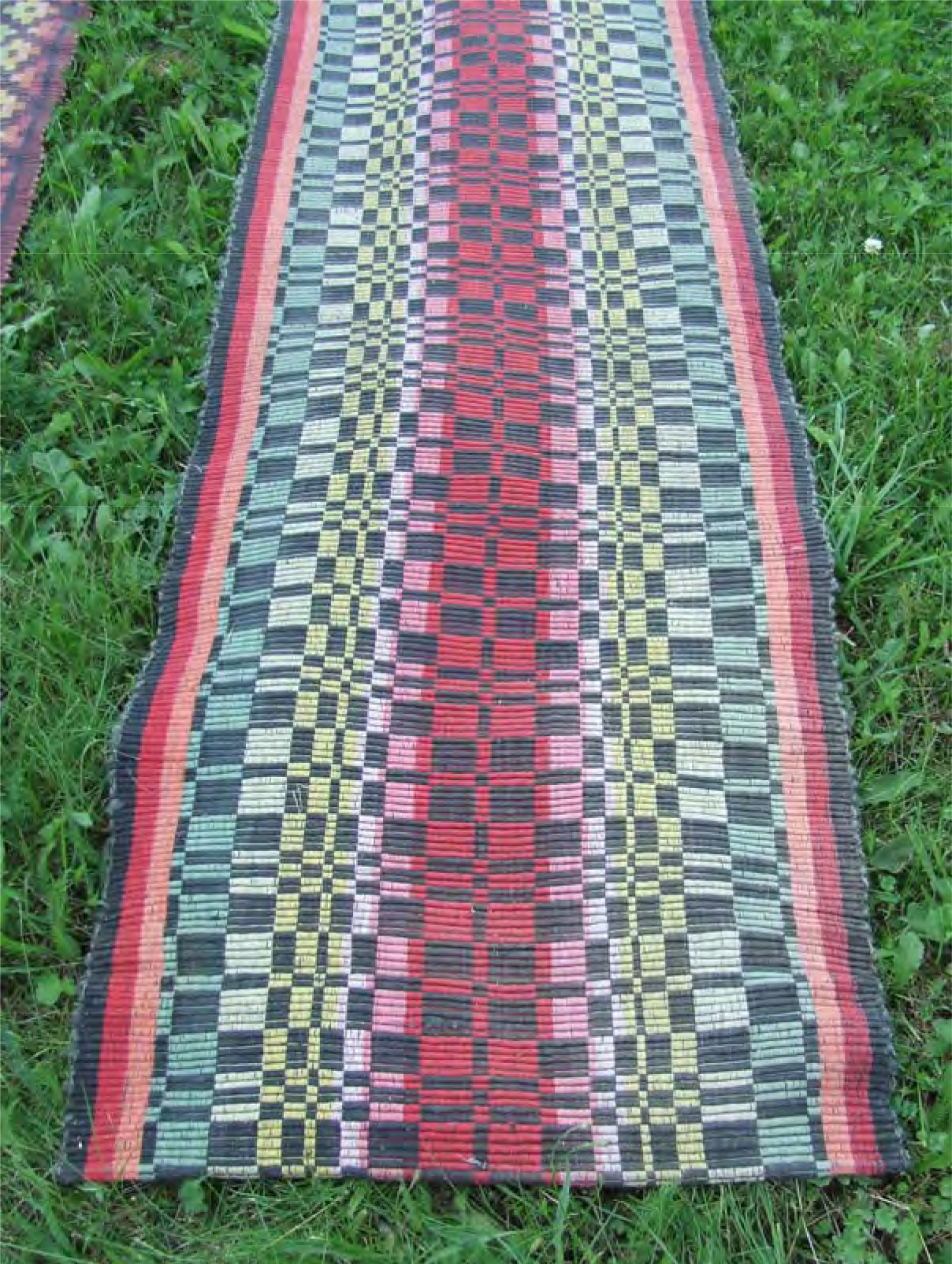
Malle is not real. Malle is just some name. I didn’t have much of a choice. All the women that Veinika Västrik interviews for her research on Avinurme rugs have chosen to remain anonymous.1 I respect their decision, but I’m fed up with texts that turn women into a uniform category, a nameless mass. In which they feel like they’re not important enough or as if they haven’t been considered worthy of a name.
At this point, I’m taking the reins, using the tricks that, as an artist, I might know better than any self-respecting historian. Where facts run thin, I allow my fantasy to roam, turning to storytelling as a research method.2 I think of story-creation as a filling solution that fits nicely into archival gaps, and with its fictional nature, it allows us to playfully envision even the life stories that until now haven’t been considered worth documenting. This kind of critical storytelling sheds light on how Avinurme rugs and craft knowledge in general have remained on the margins of big history, at the same time allowing us to pull them in from the fringes and salute them with flickers of fiction. Naturally, employing make-believe as a method for historical research requires ethical cautiousness, and I find myself asking: where does the line between me as a storyteller and Malle as an object of research lie? At which points do I tend to look at the past through contemporised glasses, rendering the present of that time equal with the values of contemporary times?
But let’s get back to Malle. Malle is special. She lived differently, against the grain. She was a master of weaving on the loom. Malle was weaving illegal rugs from threads that reached her in unlawful ways, and she sold her handicrafts to clients that shouldn’t have partaken in counter-state activities. Malle was resourceful, clever and self-willed. She wouldn’t sit around unoccupied and succumb to rules. Of course, Malle wasn’t the only one. Her beautiful fabrics came to be only thanks to collaborators, co-weavers carding in the opposite direction.
In my head, Malle has become an icon or a character, but I’m still unsure if it’s right to cross-examine Malle with my text like this? Am I building her up into an inspiration that I have been missing? Am I, perhaps, too resourceful a writer or simply an honest opponent of patriarchal structures, who knows how rare facts about other kinds of women are? Sometimes you need to concoct the things that never made it onto paper, in order to notice those who’ve been considered too unimportant to be heard in full, too silent to be acknowledged for their role in the path towards freedom.3 No, I’m not just talking about the freedom of a nation state, but of resistance in everyday life. Malle has encouraged me, told me that doing things correctly doesn’t always bring us to the finish line. That it’s better to bend the rules, use our heart to listen to the evidence, search the hems of skirts for facts, and write in the back room without thinking what others will make of my work.
Malle lives close to Avinurme. But her story starts somewhere much further away – at the other end of the Soviet Union, in the cotton fields of the steppes of Uzbekistan. Scorching sun on a never-ending plain, countless pairs of hands collecting clumps of decoloured fluff, and drought. Full bodies of water were emptied before the Union’s organs of power were forced to acknowledge signs of an ecological catastrophe.4 At the height of the cotton industry in the 1970s, Malle was a few thousand kilometres this way, producing her rugs in peak shape. And these two things are undoubtedly connected. I would like to know how many hands touched the plant fiber before it reached Malle? Who was cooking for the teens that whispered secrets between the field rows, who was sitting at children’s bedsides and holding their cracked hands, knowing too well the pain that was making them cry? Who drove the load of cotton to Narva? Who, now much closer to Malle, spun the raw material into thread on the complex machines of Kreenholm? In a factory between two channels of the river, was it the sound of roaring machines that allowed the factory girls to make plans, or the deep disappointment in the whole Soviet system that made them resort to stealing?5 Was their decision to slip extra pay under their skirts a revenge for this bloody, brutal and dried-up chain of production? Can you even call the workers’ quiet protest stealing? Were the ends of bobbins and small machine parts not the payment they deserved? Were their activities a political resistance or plain necessity? Perhaps it doesn’t even matter.
“She was going around the village, knowing right away where there would be buyers. Where did she get them? She didn’t happen to say? – No, I definitely don’t know where she got them. Must’ve gotten them from a factory where they were dying them. /--/ You wouldn’t talk about where you got them, because that was… Yes.”6 In whispers, Mustvee became the centre of illegal trading. There, the caches of contemporary factory girls were sold on to traditional weavers. Really, it was far from tradition, in this region, cotton – which was the main under-the-counter good – had never been this widely spread. The locals were resourceful, coming up with new systems of weaving on old looms, adapting tricks from techniques for setting up warps for wool or linen.
One of the hot items was thread no. 10.7 Thread no. 10 is not too thick; I would consider it a little too thin even for embroidery. Impressively, quite a few of Avinurme’s weavers managed to make rugs out of it. No. 10 was also the favourite product of Malle. Malle would walk to Mustvee. There was no bus, but even if there had been, she probably wouldn’t have dared to step in one with her big bags of thread. She was followed by a tremulous tension. She had given this some thought. She didn’t think she was doing anything wrong, but she knew that getting busted was a possible scenario. Malle timed her visit so that she would be walking to Mustvee during daylight, and she preferred to return in the dark. That way it was easier to leap into a bush if a car came flying past with its bright lights searching. She had an agreement with herself: always remain alert. Once she got home, she would only unpack her bundles in the back room, with the curtains closed and the door always shut, grandmother’s loom pushed against the wall. In this way it was easier to get the rug nice and tight, a floor textile must be durable.
In a way, Avinurme rugs are reversed textiles, where warps create a pattern using colour transitions. The pattern was the result of the fact that there was never enough material to make a monochrome rug. In Mustvee, only ends of colour lots and half-used bobbins were sold. You had to make combinations. It must’ve been easier to slip one spool of thread in your pocket at a time. It’s hardly a revelation that you shouldn’t steal too much from the same lot. Malle had browsed pre-Soviet craft magazines and found inspiration for a warp rep woven rug. “It was quite a… which colours to put where, to make sure that you don’t mess it up while warping, it was a whole science in itself. /--/”8 There were other makers, too, that had come to the same solution when using thread no. 10. A rug technique – or even a style in its own right – emerged. Makers learnt from one another and exchanged tips between themselves. Someone supposedly used oil filters from a tractor as weft, and Malle had heard about milk cartons being used, too.9 She preferred flax tow, which was naturally a little more difficult to procure, but there was still enough in grandmother’s stash.
Malle was proud that there was flax tow in her rugs. Since she was a child, she had been taught that our nation was built on flax.10 She had never understood what the saying meant but a kind of magic came over her once the warp was up and she started winding the shuttle with the tow. And she was proud of the fact that the pattern came from a pre-Soviet magazine – what she didn’t know, of course, was that First Republic-era rug designs were often heavily borrowed from the carpets of Baltic Germans. Malle considered rep-weave rugs a sign of her free will. While weaving, the stress went away, her hands were at work, her head quieter than usual, the future shed its grey hue.
“Finished rugs were packed by first folding them twice lengthwise, then rolling them up tightly. These kinds of compact rug rolls were ready to be taken on a sales trip.”11 Malle often drove a car to Rakvere, with rug rolls in the trunk and bravery in her heart. She would’ve preferred weaving at home over ringing one doorbell after the other in pre-fab apartment buildings. But in the city, the rugs were purchased at higher prices, and there were more clients, too. There, people didn’t know how to weave anymore, the apartments were too small for looms. The rugs stayed in the car at first, and only a small sample, this way it was easier to get out of the situation if you happened to meet the wrong person. Malle preferred to sell based on recommendations, but even then, you couldn’t be sure who you’d run into. Once, she took the whole cargo straight to an acquaintance’s door. Climbed all the way up to the 4th floor, opened the door and was just about to announce herself with a hello. Then spotted the hat of a militia hanging from the rack. Pressing her lips together tightly, she turned on the spot, started up the car and sped back home. Always remain alert!
As the production volume at Kreenholm slumped, so did Malle’s weaving frequency. It was already during the newly independent republic, when Malle was rarely seen at the loom anymore, when she happened to read an article in the Postimees newspaper: Kreenholm reacted fast to the Finns’ suspicions.12 The article describes the Finnish company Marimekko halting all import of Uzbekistani cotton as they suspected the production chain involved child labour. It didn’t surprise Malle much that the cotton industry of a former Soviet republic would still be using child labour. She knew that, just like she had to plough potato fields in her school years, other teenagers would go to the steppes to farm cotton. Of course, now all of it was illegal.
Instead, she felt ashamed in a way, for it had never crossed her mind where the thread that was slipping through her hands for years – no. 10 – came from. According to the newspaper, Uzbekistani raw material now made up only 8% of what Kreenholm was using, but Malle was certain that back in the day, that number might have been close to 80. And she had been too caught up in her own little life and problems, too caught up in trying not to get busted by a patrol. Shameful that she had never put the big picture together before. Her thread no. 10 did not start with the pickpockets at Kreenholm, but much-much further. Her hands fell heavy into her lap and Malle’s sleep was haunted by images of sisters on the steppes, with threads running from their bodies to Malle’s loom, and the warp melted into her fingers. In this image, somewhere far away lay bluish flax fields and the carpets of Germans similar to those of Avinurme. But in her dream, Malle was counting her warps over and over, so as not to mess up, God forbid. In her old age, her body wasn’t carrying as much tension from constant hiding anymore. She was often snoozing in a chair in the back room, an intricate Avinurme rug under her backside.
Mia Tamme
12 March 2026
Kreenholm, Narva
The research portion and an early version of the essay was completed in 2025 as part of the MA work Old Girls at the Dutch Art Institute, under the careful supervision of Grant Watson. I would like to thank Veinika Västrik who taught me how to weave on a loom and whose interviews in Avinurme made this writing possible.
References
- Veinika Västrik, Avinurme lõimeripstehnikas põrandakatted Eestis ilmunud kudumisõpetuste ja muuseumikogude taustal ning katsed kasutada lõimeripstehnikat tänapäevaste linaste materjalidega kudumisel. Master’s thesis. University of Tartu Viljandi Culture Academy, 2013.
- Here, I’m referring to the American academic Saidiya Hartman, who in her essay “Venus in Two Acts” introduces the term critical fabulation, a writing methodology where archival research, critical theory and creative writing meet.
- Although Piret Karro talks about a different era, my thinking about Kreenholm’s workers is influenced by her article “150 aastat eesti feminismi”, Vikerkaar 3 (2022), 57–112.
- Art in the Age of the Anthropocene, curators Linda Kaljundi, Eha Komissarov, Ulrike Plath, Bart Pushaw and Tiiu Saadoja, exhibition, Kumu Art Museum, Tallinn, 5 May – 8 October 2023.
- Västrik, 43.
- Västrik, 43, interview with a woman, b. 1935.
- Västrik, 17.
- Västrik, 45, interview with a woman, b. 1951.
- Västrik, 18.
- Linakasvatusest Eestis – lina eest vabaks, Mulgimaa <www.mulgimaa.ee/mulgi-keel-ja-meel/ajalugu/linakasvatusest-eestis-lina-eest-vabaks> [accessed 12 March 2026].
- Västrik, 48.
- Jano Purga, ‘Kreenholm reageeris soomlaste kahtlusele kärmelt’, Postimees, 27 November 2007 <https://majandus.postimees.ee/1731895/kreenholm-reageeris-soomlaste-kahtlusele-karmelt> [accessed 12 March 2026].