Published on 3.07.2026
Vitali Valtanen is a designer and PhD candidate and junior researcher at the Estonian Academy of Arts (EKA). In his work, he asks the question that remains yet unanswered in design: who is it that we actually create for, whose rights and needs do we take into account? With a background in product design and experience in architectural and urban environment projects, he has designed spaces and objects in the scale of and for humans – and since 2017, he has also been teaching that at EKA. In his PhD work, he is developing design methodologies that acknowledge non-human animals as active subjects of the urban environment. He is moving from a human-centred design practice towards a design that recognises the existence of other animals as an ethical responsibility, rather than a choice.
Animal leather is one of the oldest materials that humans have made use of. Before it became a raw material, it belonged to a different body. The skin of that body was the first boundary between them and the world – a feeling, a defence, an experience of being alive. Objectifying does not start at the moment when the skin is taken off the animal – it starts earlier, and it is systematic. A cow, kept for producing milk, a chicken whose body is optimised for eggs, a calf that is separated from their mother right after birth – all of them are bodies whose existence has been redesigned for the benefit of humans: oppressed, optimised, shaped to fit a production process. Leather is the most visible trace of that hierarchy: turning someone’s body into material is the ultimate objectification – the subject has become an object with a price, an elastic modulus, and a spot in the material catalogue, but without a name as a being. This is where copy work starts: the animal body is not just erased from the process of production – it is reclaimed as a motif, made aesthetic, commercialised.
This article asks: when is copying presented as a neutral, aesthetic act, and when is it a speciesist1 design practice that is simply well designed?
From Someone to Something
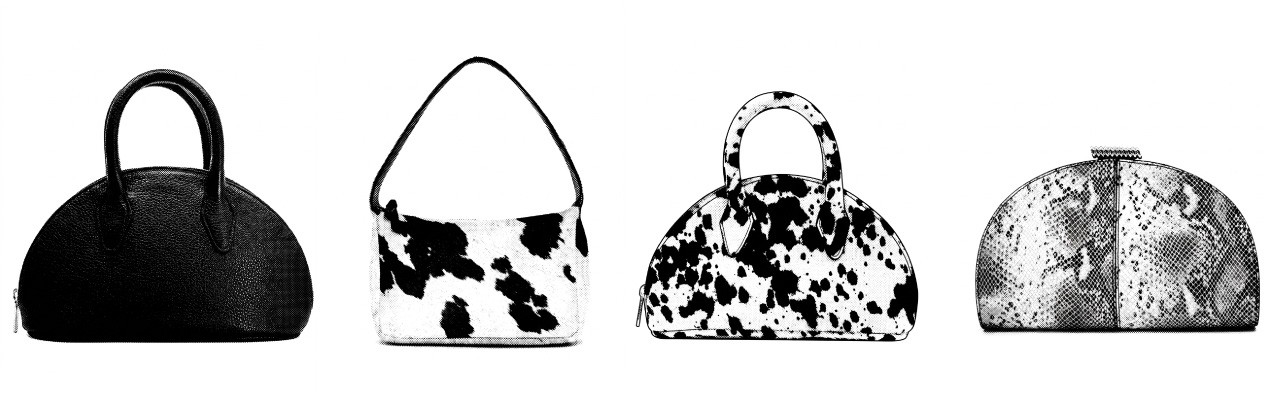
In front of us, there are four bags. All of them are sewn by hand, each of their proportions are carefully considered, each one is real. The surface of the first one is evenly black, smooth and perfect. The second is patterned with big, chaotically placed patches. The third has an even more spotty, compact design – recognisable, even cute. The fourth has the dense geometrical relief of a reptile, evoking a sense of unease upon touch. From a design perspective, there is nothing odd here: timeless forms, carefully considered seams, material that says something about the wearer.
If someone was asked to choose one of the bags for themselves, the choice would probably be quick and easy. The black calf leather is a classic choice, the cow leather is recognisable, the reptile pattern exotic but prestigious for some clients. The Dalmatian print might make you smirk: a decision that is cute and a bit bold.
But what would happen if it was mentioned that the Dalmatian pattern is not a printed copy mimicking a dog’s coat, but leather from an actual dog? Not artificial leather, not an analogue – but a dog whose skin was so beautiful that someone decided to keep it. Most of us would probably stop there. Some would put the bag back. Some would feel nauseous or enraged.2 But in some cultures, this has been an ordinary product. Same material, same process, same outcome – just, in a Westerner’s eyes, the wrong animal.
This is where an odd paradox of copy work lies. A printed copy of a Dalmatian’s coat pattern is acceptable, even cute. An original – same pattern, same animal – is unacceptable. The copy is morally purer than the original.
Design theory, like philosophy and art history in general, typically considers the original superior: the original is authentic, the copy is an imitation, a shadow, secondary. But when it comes to the bodies of animals, this hierarchy is turned upside-down. The further away we move from the original, the more thoroughly the animal’s body is copied, processed and anonymised, the more at ease we are with the material. Traditionally, a copy should bring us closer to the original: it repeats its patterns and properties. With an animal’s body, the opposite happens: every copy, every step in the processing separates us further from the original, until we are left with material without a body. Too true to the original is bothersome because the original is a someone. The exception seems to be the leather of an exotic animal that is sold specifically as an original – but even here, the animal themselves is hidden: what is purchased, is rareness, not a subject.3 The copy is comforting because it is an object without an origin – it is something that simply is, not someone who was. And this very shift from someone to something is where the real task of copying lies: it is not just a technical process, it is a moral rearrangement. Every step of processing, every layer of finishing buries the original and usually makes it easier to consume.
This is not coincidental. This is design – a slow, accumulative process that has created a norm which we now consider the default, and that should be questioned.
Embodiment
A bag is an item that is held. A jacket is an item that is worn. Leather warms, protects, affects the posture. In design language, leather is described using words that mainly refer to its properties, not its origin: durable, breathable, natural, luxurious. Sometimes it is said that good leather lives with its wearer – it changes, bends, keeps memories. Other times it is said that leather is an autonomous material with its own character and biography. These two rhetorics seem contradictory, but they serve the same goal: they address the wearer, not the animal that the leather comes from. A biography requires a subject. And that subject – an animal, part of whose body that leather used to be – is erased from a design brief before its writing begins.
In this context, copying is something more than just using a material: someone else’s body is wrapped around one’s own so completely that the line between the original and the copy becomes physically non-existent. It is embodiment in its most literal sense – the skin of another species around one’s own meat. A jacket is a perfect copy exactly because it is an original: it is the skin, it fulfils the functions, it is the body, but the animal all of this comes from is not present anymore. Only properties remain, but not the one whose properties they used to be.
Tools for Disappearing
Material is not the only thing shaped by design. Before the animal’s body becomes a product, it has repeatedly undergone linguistic remodelling – it has been named, renamed, categorised. Language functions like skin: it smooths out, hides, erases uncomfortable details and buries the original under words. One of the more distinct examples is the phrase “humane slaughter” – not a technical term but a linguistic design decision, made by producers, marketers, the ones setting the standards. It functions just like visual design, hiding the actual content and shaping the experience of the recipient.
The animal lived a good life and was slaughtered humanely – this justifies all of it. But the word humane comes from the Latin humanitas, which refers to human nature, kindness, care. How can you use kindness to slaughter another being that wants to live? This is not a rhetorical question – it is a linguistic contradiction which is completely normalised in design consumption. Humane slaughter does not describe the experience of the animal. It describes the slaughterer’s conscience.
Design is not just concerned with materials, it reaches language too. Secondary product is not a neutral technical term; it is a linguistic design decision that functions under the same logic as humane killing. The fashion industry presents leather as a secondary product of beef production – something that would otherwise go to waste. But economically leather is a by-product of the meat industry: the financial reports of slaughterhouses reveal that a drop in cattle hide sales causes them millions in losses. Collective Fashion Justice, whose research is coordinated by Emma Håkansson, systematically documents this contradiction – including in the documentary SLAY – and points out how the narrative of secondary products hides actual financial dependence.4 Secondary products does not describe reality; it describes what the producer wants us to think. The original – the cow stripped of its skin – gets lost behind the term secondary product.
The well-known vegan feminist author Carol J. Adams calls this the mechanism of the absent referent: the animal’s body is physically present but the animal as a subject has been erased from representation.5 Package design is one of the main tools of this mechanism. Leather is not the only material in which this logic is used – copying functions as a structural principle in all animal products. It is most clearly revealed in the packages of food products where design does not just copy the pattern, but the animal’s whole existence.
The illustration on a typical milk carton is a cow, joyfully drinking milk from a cup. The visual is carefully designed to evoke a positive emotion. The cow on the package is smiling, she is giving out milk voluntarily, happily. In actuality, cow milk – as with any mammal’s milk – is meant for her child, a calf. A cow does not give milk; it is taken from her. The milk industry could not exist without separating calves from mothers and taking their milk. Special processes and equipment have been created for this: the cow is artificially inseminated, the calf is separated from her right after birth – male calves are killed, females are kept in the production cycle.6 This whole system is carefully designed and yet we don’t call it design. The original is hidden behind the copy – she is inside the package, exactly 1.5 litres of her.
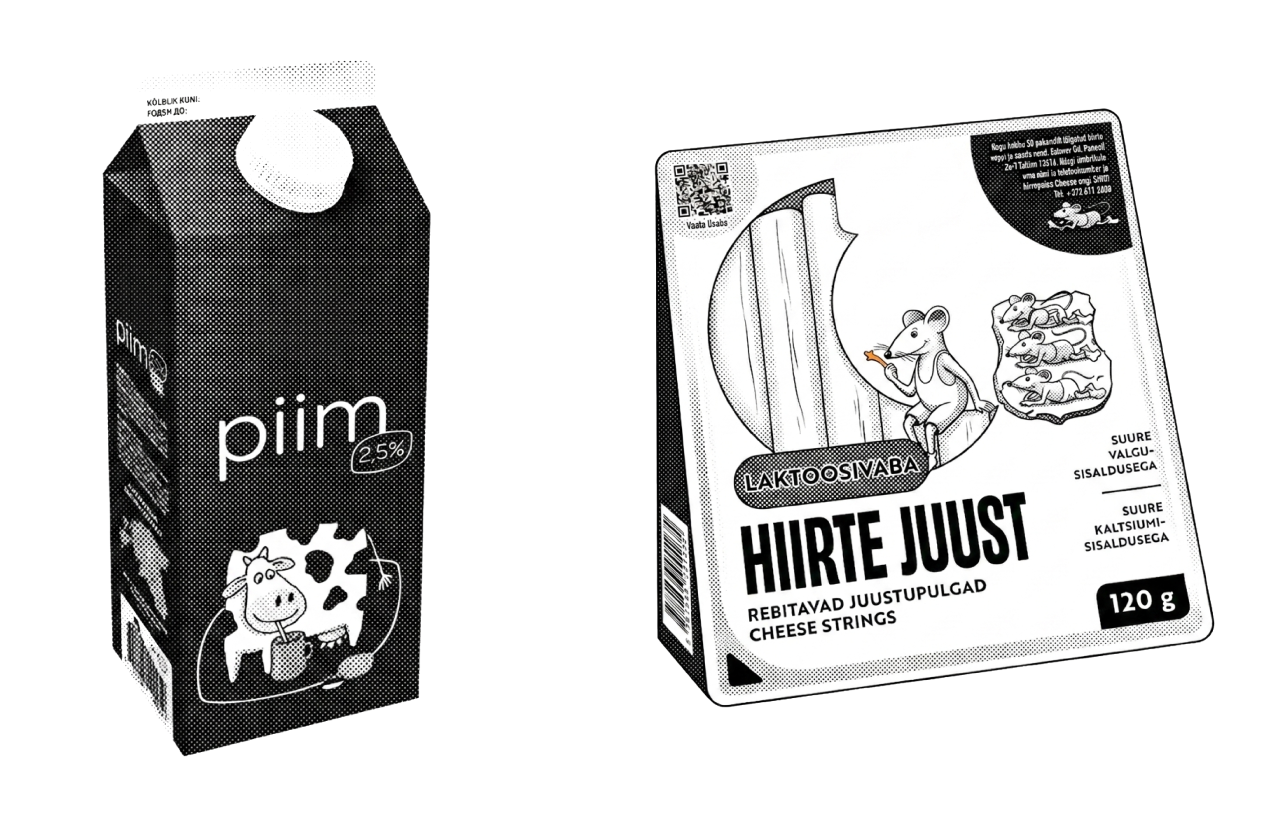
The product Hiirte Juust – “Mice’s Cheese” – functions differently but it reveals something even more interesting. There is no cow on the package – her place is taken by mice, happy, anthropomorphised, cultural characters that we recognise from fairy tales and comic books. The idea that mice love cheese is so deeply ingrained in our cultural consciousness that nobody asks if it is true. In reality, mice prefer grain, they do not care much for cheese. But that is not important because the packaging is not about mice. It is not about the cow either. It is about the connections we are used to, uncomplicated images, consumption as a cultural practice with its own symbolic language.
Looking at speciesism philosophically, politically and culturally, from the viewpoint of critical animal studies,7,8 this is a telling example of how animals simultaneously exist in two very different roles within our consumption culture: some are cute, relatable characters with personalities, others are anonymous production units whose bodies are inside packaging but whose existence is not worthy of a mention.9 The mouse is a subject – with a face, a personality, a will. The cow is a resource – she has a fat percentage and an expiration date. This is not an arbitrary distinction. This is speciesism in packaging design: a systematic decision about which animals are granted subjectivity and which are not. The milk package hides the original behind a happy copy. The packaging of Hiirte Juust replaces the original with the cultural image of a different animal.
Yes, both packages are well designed. They are clear, memorable, aimed at a target group. This is exactly the problem: with animal bodies, copy work is not defined by bad design. It requires good design. The better the design, the more completely the original disappears.
Refusal as Design Practice
This selective erasure is called speciesism: discrimination based on species, determining whose life is worth protecting and whose body is free for use.10 Speciesism is not an exception or a radical ideology – it is a norm that is rarely questioned. Design is not passive in this process. Design is one of the main tools for repeating and normalising these habits. The use of fur has been widely deemed immoral – the Estonian Parliament banned fur farms in 2021, the ban came into full effect on 1 January 2026.11 But cattle leather will remain widely used among designers, despite the ever-growing research in the field of alternatives: leather made from cactus, mycelium and lab-grown bio material are being actively developed as the more ethical option.12 Veganism as an ethical position asks why we treat different animal species differently.
Victor Papanek wrote in 1971 that designers are some of the more dangerous people in the world because they design the environment where others live, and often without taking responsibility.13 Half a century later, Mike Monteiro claimed that design is a political act and every design decision is a question of responsibility – even if it seems merely aesthetic.14 But both Papanek and Monteiro were writing about humans. In the context of their design responsibility, the user is a human, the oppressed party is a human. Society consists of humans. Animals are absent from the discussion. This absence is not accidental. It’s a speciesist design decision – choosing whose oppression matters and whose oppression simply constitutes a production process.
If copying is one of design’s base operations, the question arises, what is its opposite? I suggest two terms for the context of copy work.
Uncopy is a refusal: the decision not to copy a shape, material or narrative that assumes the exploitation of an animal and a use of their body. Not because there is no alternative, but because copying in itself is a problematic act – it makes the original, the life and agency of the animal, invisible. Uncopy is not passive inactivity. It is part of an active designer decision that Erik Sandelin calls grace: actively not doing, withdrawing from force where it would do harm.15 Monteiro said that a designer cannot hide behind the brief. If we design something, it means we have produced it.16 Uncopy adds another layer to this: whose body does design actually exploit?
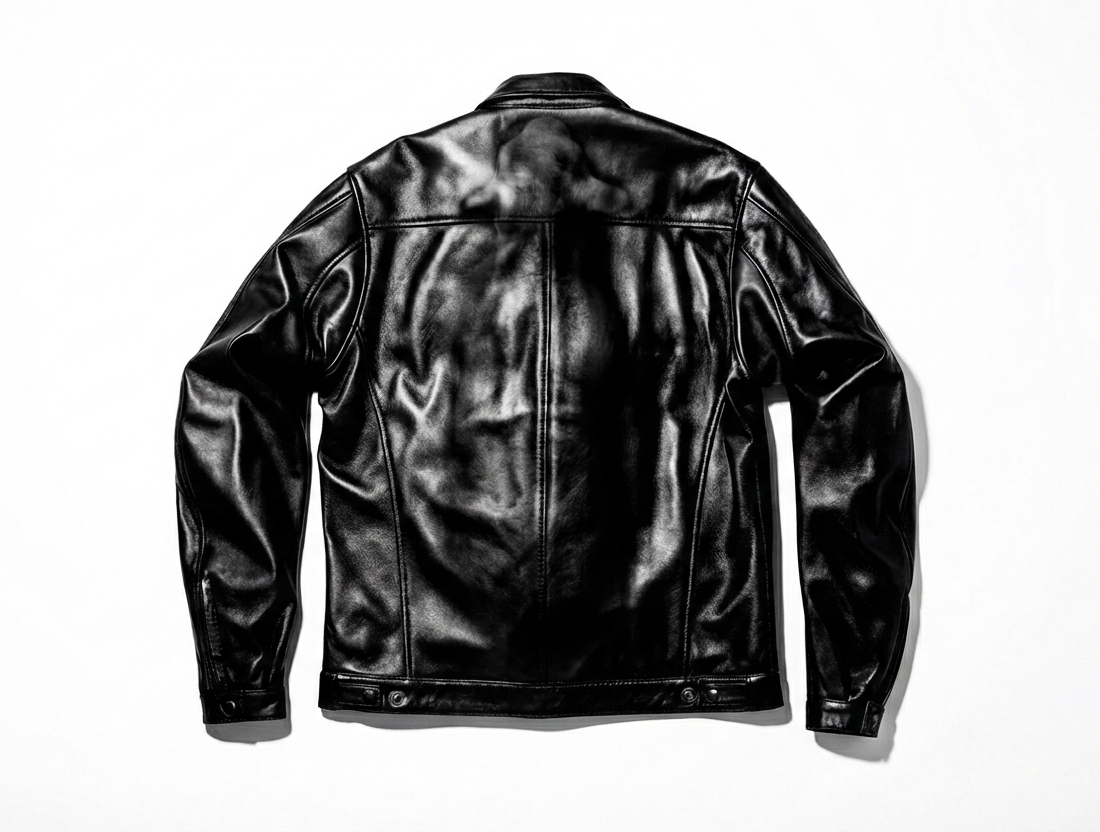
Decopy is making something visible: retrospection unveiling what copy work has been hiding brings back the absent referent. In the photo of a leather jacket, there is a barely visible shape in the middle: an animal’s silhouette that remains under the surface, nearly erased, but not entirely. It is an attempt to decopy in visual language – a reminder for everyone who makes that decision: for the consumer, designer, producer. There was an original. There still is an original somewhere under this surface.
But this is precisely what design theory has been avoiding – even when it talks about interspecies relationships. In the last decade, design theory has clearly moved towards multispecies and interspecies design17 – De Roo18, Poikolainen19, Nicenboim20 and Wakkary21 talk about decentralising design, the coexistence of species and more-than-human design, asking, who matters in a design process. It is an important shift that shows that design theory is capable of change. The question is, what should be added next: not just interspecies rhetoric, but also interspecies ethics applied to production processes. Because while design theory is busy with bees and fungi, the same design culture continues the use of calf leather and sheep wool, with almost no questions asked. The rhetoric of interspecies design and the reality of everyday design practice do not meet – the gap in between is filled with silence, the same one that enables the phrase human slaughter.22
It is a structural problem: design discourse has adopted a language that is concerned with interspecies questions, but not ethics. Even those critiquing designer’s responsibility – Papanek, Monteiro – failed to ask about their responsibility to other-than-humans. This gap is in itself worthy of analysis.
Interspecies design that takes the agency of other-than-human animals seriously must look beyond urban birds. We have to start asking what is behind the closed doors: which animals are kept in the food system of this city, which animals’ bodies have been turned into material, and in which ways does design keep it all invisible. Studies show a direct association between the abuse of animals and violence between humans – this is not a metaphor but a quantifiable correlation.23
The leather jacket stays on. While wearing it, we might not even think to question whose body it used to be. And this is exactly what copy work of animal material is attempting to do: erase the original so completely that the absence goes unnoticed – or so that the original remains exactly visible enough to sell the exotic.
We have to practice exactly this: noticing absences. The same attention that we put into assessing ergonomics or sustainability can be applied to the question: whose body, whose life, whose agency has been made invisible here? This is a call for attention – and sometimes, the question of whose body we are working with is the most important design decision we make.
It is said that good leather copies the character of its wearer. The question is, which wearer – and what does the copying say about the wearer. The same logic applies to food: we are what we eat, but we rarely ask, who we ate – and even more rarely, who that body belonged to.
References
- In philosophy, the term was first used by Peter Singer in his work Animal Liberation, defining it as a prejudice that automatically asserts the interests of humans above those of other animal species.
- Andrew Weisman, Is Your Leather From China? It Might Be Made of Dog or Cat Skin (Houston: The Guardian, 2016).
- Tom Regan, The Case for Animal Rights (Berkeley: University of California Press, 1983).
- Emma Håkansson, How Veganism Can Save Us (Melbourne: Collective Fashion Justice, 2022) <www.collectivefashionjustice.org/leather> [accessed 19 February 2026].
- Carol J. Adams, The Sexual Politics of Meat: 35th Anniversary Edition (New York: Bloomsbury Academic, 1990).
- A. W. Byrne and others, ‘Trends and Factors Associated with Dairy Calf Early Slaughter in Ireland, 2018–2022’, Frontiers in Veterinary Science, 10 (2023), 1178279 <https://doi.org/10.3389/fvets.2023.1178279> [accessed 19 February 2026].
- Steven Best and others, ‘Introducing Critical Animal Studies’, Journal for Critical Animal Studies, 5.1 (2007), 4–5.
- Anthony J. Nocella II and others (eds), Defining Critical Animal Studies: An Intersectional Social Justice Approach for Liberation (New York: Peter Lang, 2014).
- M. Westerlaken and E. Sandelin, ‘Design by/for/with/about/without Animals: Tactics for Animal Liberation’, in More-Than-Human Design in Practice, ed. by A. Poikolainen and others (London: Taylor & Francis, 2024).
- Peter Singer, Animal Liberation (New York: HarperCollins, 2015; first published 1975).
- Riigikogu keelustas karusloomafarmid, Eesti Rahvusringhääling, 02.06.2021 <www.err.ee/1608232770/riigikogu-keelustas-karusloomafarmid> [accessed 19.02.2026].
- Amobonye, A., Lalung, J., Awasthi, M. K., & Pillai, S., Fungal mycelium as leather alternative: A sustainable biogenic material for the fashion industry, Sustainable Materials and Technologies (2023) <https://doi.org/10.1016/j.susmat.2023.e00724> [accessed 19.02.2026].
- Victor Papanek, Disain tegelikule maailmale (orig. Design for the Real World: Human Ecology and Social Change, 1971) (Tallinn: Eesti Kunstiakadeemia Kirjastus, 2023).
- Mike Monteiro, Ruined by Design (San Francisco: Mule Design, 2019).
- Erik Sandelin, Design and Grace: An Ahuman Odyssey (Stockholm: Konstfack Collection, 2024).
- Mike Monteiro, Ruined by Design.
- Interspecies design asks how we design a world that is shared with other-than-human animals – who is visible in a design process, who’s interests matter, who’s body can be used.
- Bart De Roo et al., Decentering Design – Practice in a More-than-human World (Gent: Art Paper Editions, 2024).
- Aino Poikolainen et al. (eds), ‘Design by Animals’, in More-than-human Design in Practice (London: Taylor & Francis, 2024).
- Iohanna Nicenboim et al., ‘Decentering Through Design: Bridging Posthuman Theory with More-than-Human Design Practices’, Human–Computer Interaction (2023) <https://doi.org/10.1080/07370024.2023.2283535> [accessed 19 February 2026].
- Ron Wakkary, Things We Could Design: For More Than Human-centered Worlds (Cambridge: MIT Press, 2021), pp. 2–5, 35–37, 185–192.
- Marnix Westerlaken and Elin Sandelin, ‘Design by/for/with/about/without Animals: Tactics for Animal Liberation’, in More-than-human Design in Practice ed. by Aino Poikolainen et al. (London: Taylor & Francis, 2024).
- Sergio Monsalve, Fernanda Ferreira, and Raul Garcia, ‘The Connection Between Animal Abuse and Interpersonal Violence: A Review from the Veterinary Perspective’, Research in Veterinary Science, 114 (2017), 18–26.