Published on 3.07.2026
Immanuel Koh is Assistant Professor in Design & Artificial Intelligence (DAI) and Architecture & Sustainable Design (ASD) at the Singapore University of Technology and Design (SUTD), where he directs Artificial-Architecture. A pioneer in AI x Architecture and Principal Investigator for several funded AI research projects (e.g., AI Singapore, DesignSingapore Council, Zaha Hadid Architects, MVRDV), his work has been featured at premium AI conferences, awarded design prizes, and exhibited worldwide. Koh represented Singapore at the Venice Architecture Biennale 2025, leads Singapore’s Built Environment AI Centre of Excellence (BE AI CoE) and chairs NeurIPS Creative AI Track 2026.
Justin Zhuang is an observer of the designed world and its impact on everyday life. Since 2009, the journalism graduate has covered architecture and design for magazines in Singapore and around the world, including BiblioAsia, CUBES, Metropolis, Eye on Design and Works That Work. He has authored several books and projects on design in Singapore, including INDEPENDENCE: The history of graphic design in Singapore since the 1960s (2012) and Everyday Modernism: Architecture & Society in Singapore (2022). Together with his partner Sheere Ng, Zhuang runs In Plain Words, a Singapore-based writing studio and publishing imprint. justinzhuang.com
With its ability to learn and simulate all sorts of aesthetic styles, Artificial Intelligence (AI) is arguably a powerful tool for imitation in design. The technology, however, is still in development and has often generated unexpected outcomes. These have ranged from extra fingers to distorted faces, although they have become increasingly less common. While such outputs are typically regarded as limitations of AI to be solved, architecture and AI professor Immanuel Koh argues they should instead be seen as artefacts of its generative logic. They represent the native expression of AI or what he calls Neural Tectonics.
Since 2020, Koh and his team at Artificial-Architecture have sought to theorise this by using AI to generate furniture designs. The latest being Neural Monobloc Black, which reinterprets the ubiquitous monobloc chair using a custom fine-tuned text-to-3D AI model. The results are eight warped and distorted chairs that sit awkwardly in our eyes and minds, raising the question of whether these are aberrations of AI or its very nature. Might designers be using AI all wrong? Such experiments highlight the issue and meaning of authenticity in the age of AI.
Justin Zhuang: Can you tell us more about the Artificial-Architecture lab you started at the Singapore University of Technology and Design (SUTD)?
Immanuel Koh: My research lab is called “Artificial-Architecture” for several reasons. One is that architecture is artificial, right? It is man-made. And by joining the word ‘artificial’ and ‘architecture’ into a hyphenated compound, a negation is achieved, resulting in an architecture that is hypothetically real or authentic. In short, you could say that the lab investigates artificial intelligence (AI) through the lens of architecture, and vice versa. Artificial intelligence for us is not constrained by computer systems but could also be biological intelligence, plant intelligence, etc. Therefore, we work on all kinds of projects, from training AI models for Singapore’s Urban Redevelopment Authority (URA) to quickly predict building planning compliances to exploring how electrical signals from the neural networks in the human brain can be used to generate personalised virtual spaces or metaverses. We are also currently benchmarking the architectural intelligence of AI models, looking at whether they could understand and reason diagrams, structure, cultural sensitivity, etc. It’s almost like trying to test if AI could pass the entire curriculum of a professionally accredited architecture degree.
The founding of the lab stems from the work I did while completing my PhD thesis at the École polytechnique fédérale de Lausanne (EPFL), which investigated “the formal basis of a machine-learnable architecture”, and whether we could potentially encode or sample architecture formally in three dimensions or in other ways. At my lab, architecture is understood very broadly across the spatial scale, and that includes furniture.
JZ: How did the Neural Monobloc Black project come about?
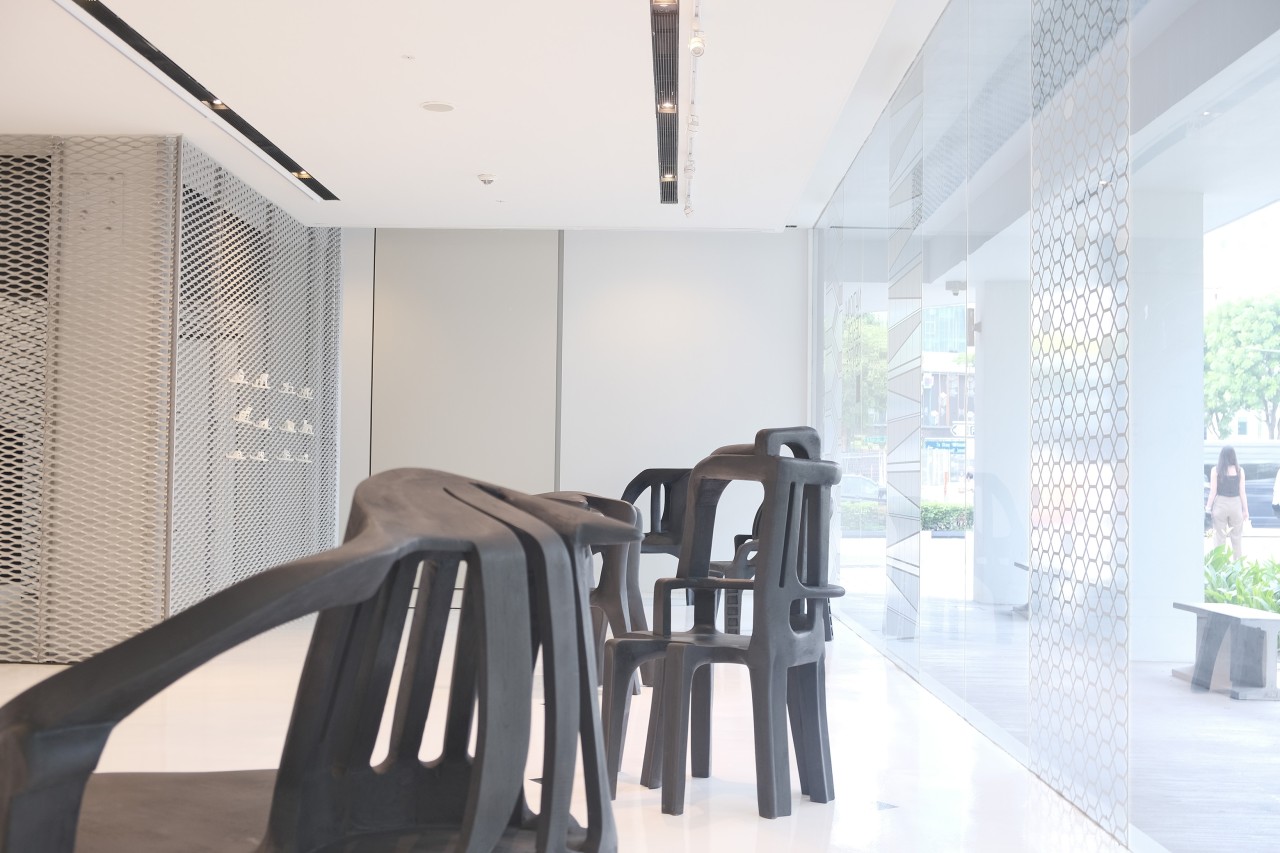
IK: Furniture projects allow me to quickly test ideas and have them built. A lot of AI artworks are usually screen-based, so prototyping in the physical world goes a bit deeper into the exploration and the manifestation of this technology. Neural Monobloc Black is a critical design project where we treat the monobloc chair as a concept. It’s interesting because most people would have used a monobloc chair but probably don’t know its name. Designers know the monobloc too, but they just kind of despise it somehow. Many have tried to critique the monobloc design by reinterpreting it, but typically in a very non-AI, manual and bricolage way. Neural Monobloc Black is a critique of such critiques and also a critique of the monobloc itself. It features eight chairs generated and fabricated directly through a custom fine-tuned text-to-3D AI model that we developed.
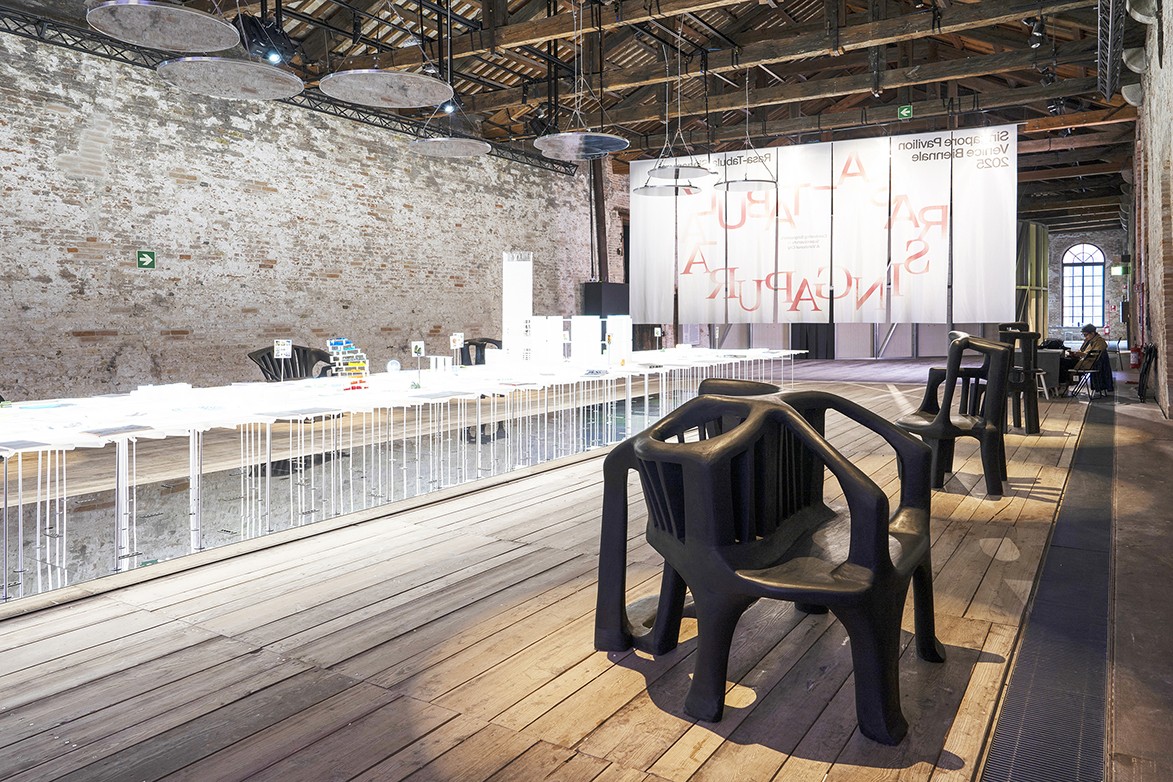
The designs are a deliberate contrast from the standard monobloc. While the latter is typically white, ours are black. They also cannot be stacked, so they’re completely annoying because they don’t serve their expected economical storage function. The standard design is injection moulded within a minute, while ours are made by artisans over a few weeks. The monobloc is light, cheap and easily thrown away but the Neural Monobloc Black is made from recycled wood charred black. Our project recognises the ubiquity of the monobloc but also creates a high-dimensional AI-bricolage from it. The designs come with all these redundant surfaces that several people can sit on, and actually help make the chairs comfortable to sit on too.
JZ: What do you mean by “high-dimension”?
IK: In the sense that the AI has learnt about the monobloc in many dimensions. For instance, when they say a deep learning model has a billion parameters, you can imagine an engine where there are a billion knobs that are trained to adjust themselves automatically to predict correctly. For example, a trained AI model that has seen a million images of cats, can kind of predict and generate how a cat looks. The making of Neural Monobloc Black consists of first fine-tuning an AI model to learn and reconstruct the monobloc chairs through several layers of multi-dimensional abstractions and finally producing them as physical objects. As an analogy, AI is learning and reconstructing the monobloc at the pixel level, which humans don’t normally do or are unable to do. So while a 10-by-10-pixel grayscale image of a chair is just a 2-dimensional picture of a chair to us, it is at first glance a 100-dimensional data point to AI.
JZ: How were the Neural Monobloc Black chairs created?
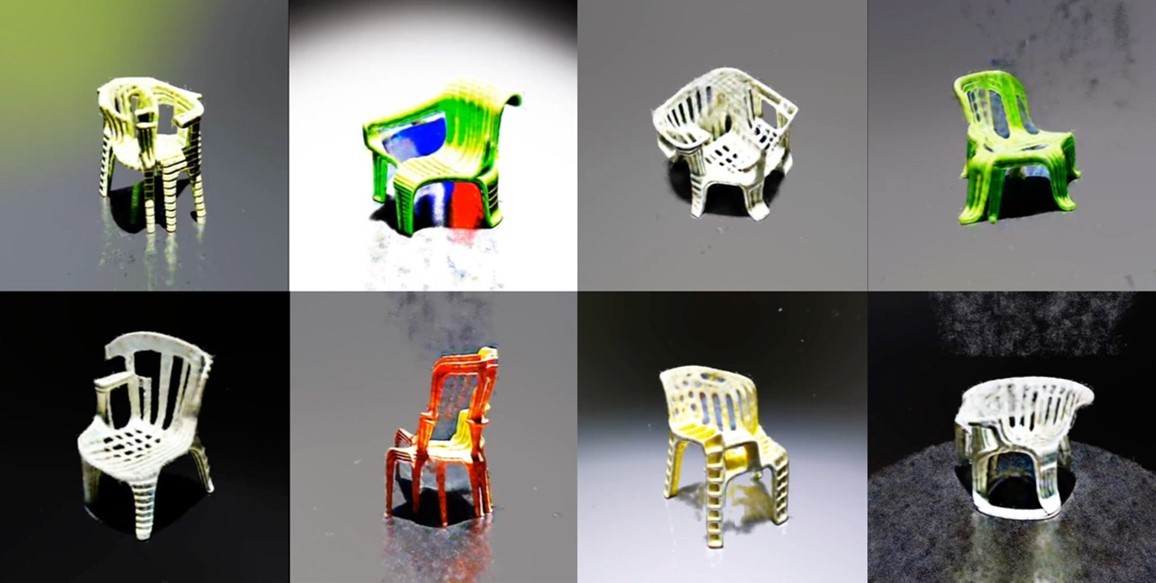
IK: We fine-tuned a text-to-3D model consisting of a NeRF (Neural Radiance Field) model for 3D reconstruction with a backbone text-to-2D Stable Diffusion model. This was fine-tuned using a technique called DreamBooth. All these were relatively new technologies in 2023 when we started on the project. The dataset used to fine-tune the model was a curated set of monobloc hallucinations initially generated from the backbone text-to-image Stable Diffusion outputs. These came from some early stage experiments to test what the model could do, such as asking it to generate an “elongated monobloc” or “a monobloc that is wide with a high back”.
Given that the backbone Stable Diffusion model is a text-to-image model, it was only trained on 2D pictures and never on 3D digital models directly. We had to finetune it within a text-to-3D AI model architecture. Essentially, the model’s understanding of 3D was 2D. It works by first generating a few 2D views for the AI model to then learn and generate the remaining views of a hypothetical 3D object. This process tends to generate multiple canonical views of a monobloc such as multiple versions of its frontal views, which looks really weird. I call it hypercubist, like how you see multiple views of the same face in a Picasso painting.
This happens because the AI model did not learn directly from a 3D dataset, and so, it becomes biased towards certain typical camera views. Like how you’re accustomed to the widely published photos of a famous museum’s facade but you have never seen its other sides which are less photogenic. In AI speak, we call it the Janus problem. Neural Monobloc Black takes this to the extreme as the model creates multiple sides of the chair, which sometimes even intersect. Many see this as a difficult problem to solve, but it’s an interesting glitch for us.
JZ: So Neural Monobloc Black is designed based on the limitations of AI technology?
IK: Yes, exactly! It’s like how early AI artworks were about hallucinations, such as humans having 11 fingers instead of 10. My project is trying to look at the limitations of AI’s deep neural network architecture. This is the design of the neural network model including its other hyperparameters such as its loss function that inherently limits and thus characterises the technology’s capability. My theory is that there is perhaps an underlying AI-native aesthetic from these systems that I term neural tectonics.1 In a sense, the ways in which AI models are constructed, how the nodes are connected to create a neural network, gives them a particular affordance in generating what’s possible and interesting.
Neural Monobloc Black is trying to surface this. But it is not a static formalism. Whenever a new neural network model is created, it will have an architecture and training set that will define its own AI-native aesthetics. Therefore, neural tectonics is kind of a moving target. Neural Monobloc Black is thus also a snapshot of a particular moment in AI model development.
JZ: Beyond documenting AI development, the project also seems to challenge what many of us see as the existing limitations of the technology?
IK: Yes, at one time it was very fashionable to see highly pixelated graphics on clothing. Such images used to only exist on the computer screens but to see them in real life was weird. Hopefully, encountering the Neural Monobloc Black chairs in real life evokes that too.
It is also about finding a kind of aesthetic language for AI, which itself is essentially a simulator of all possible styles. AI can do Van Gogh, Monet... so there is no real need to conceptualise an AI language as a style. But the project aims to conceptualise the limitations of what AI can do as an evolving style that arises as a result of its very construct. It is about seeing the limitations of an AI model as native to the very construct of the technology.
JZ: You’ve also described Neural Monobloc Black as a critique of what design is and can be. Could you elaborate on what you mean?
IK: I quoted Mark Fisher, the English cultural theorist and philosopher, who wrote that: “The weird thing is not wrong, after all: it is our conceptions that must be inadequate.” It’s basically saying that there is no such thing as a “rightness” or “wrongness” of a design, but rather we consider it wrong, hallucinated or glitched because we cannot wrap our heads around it. Theoretically speaking, the Neural Monobloc Black chairs are “wrong” because they don’t look like the original monobloc or function traditionally like one. But the “wrongness” is actually a “rightness” because it is native to what the AI models can produce. In a way, it is its most authentic expression. Therefore, it’s actually right! But we say it is wrong because we don’t know how the AI model works.
JZ: Doesn’t this challenge the view of AI as simply a tool for imitating existing styles?
IK: Yes, it is about thinking how designers can work with AI in a more original and critical way. The “normal” way of using AI for design now is to sketch something, use the image-to-image AI model to generate a photorealistic rendering of your sketch, send it to an image-to-3D AI to generate a 3D digital model, and then hopefully, send it for fabrication. There is no criticality to this process.
Can these AI models actually do more? Neural Monobloc Black can be seen as the result of “misusing” AI. Actually, I’m using it correctly because I respect its very nature. Today, most people are using AI like a black box and lose all criticality and agency over it as a tool.
JZ: Why do you think designers are using AI in this way?
IK: At least in the architecture world, such criticality is actually not important because you want to get the job done. You want to quickly iterate, choose a good design and generate the rendering quickly for the client to see. That means using AI to turn a sketch into an image, from that image into a video, and then show the clients that it is the space they’re going to have. It’s useful and productive, and this is good enough for most.
AI is also used to iterate design quickly. For example, from a single image, you can generate 10, 20 different options using different materials. But at the most fundamental level, you would still be stuck with the notion of “rightness”. Going back to the discussion, if we think a chair should look like this, AI will obviously generate the “right” chair, and then you would iterate the “right” set of options. Therefore, you cannot actually get out of that space of assumptions about design.
JZ: What’s next for Neural Monobloc Black?
IK: The project has won several international design awards, in architecture and product and even the interior design industry. It’s also been well-received at AI conferences. My next project looks at getting an AI model to generate a design diagram, which is almost the very essence of a design concept. AI models tend to be very good at generating photorealistic images and renderings, but they can’t quite interpret implicit spatial relationships generated within a diagram. The project is trying to test whether these inherently ambiguous diagrammatic reasoning representations used by designers could help highlight traces of neural tectonics from AI systems. Ultimately, I am speculating on possible AI-native aesthetics.
References
- Read more about this concept: Immanuel Koh, ‘Neu ral Tectonics’, ARIN, 4, 9 (2025), <https://doi.org/10.1007/s44223-025-00094-3>.